
Nafiul AhmadRafi
Making AI governance work for the countries not yet in the room.
AI governance researcher and policy architect, examining regulatory capacity, governance infrastructure and policy frameworks for responsible AI adoption in developing and emerging economies.

- Founding Director — Atlas AI InstituteGlobal South AI Governance & Policy Research · atlasai.institute
- National AI Policy Endorser — AI Policy LabUmeå University, Sweden
- Policy Network Member — CIVICUSWorld Alliance for Citizen Participation · Global AI Policy Initiatives
- AI Observer — AI at Large InternationalInternational AI governance observation
- Member — Internet Society (ISOC)Dhaka Chapter · Global Internet Policy & Digital Inclusion
- Member — Responsible AI HubAI Ethics, Safety & Accountability Network
My research examines the governance infrastructure and regulatory capacity required for responsible AI adoption in developing economies — with emphasis on institutional readiness and equitable participation in international norm-setting forums.
Nafiul Ahmad Rafi · Atlas AI Institute
Building AI governance capacity for Bangladesh and the Global South
Working at the intersection of technology policy and institutional development, to help developing economies adopt AI responsibly — without depending on frameworks built for entirely different contexts.
Works with
- 01
Regulatory Capacity Assessment
Evaluating institutional readiness for AI governance across Bangladesh and comparable developing economies.
- 02
Global South AI Policy
Comparative policy analysis and governance SWOT frameworks spanning 75 countries.
- 03
Multilateral AI Governance
Advancing equitable representation of developing economies in international AI standard-setting.
- 04
Digital Inclusion & Civic Technology
Connecting governance research to civic technology and digital inclusion outcomes on the ground.
Nafiul Ahmad Rafi in brief
Nafiul Ahmad Rafi is an AI governance and public policy researcher based in Dhaka, Bangladesh, working on behalf of South Asia and the Global South. He is the Founding Director of Atlas AI Institute and AI Policy Endorser at the AI Policy Lab, Umeå University, Sweden. His research covers AI regulatory frameworks, institutional readiness for AI governance, and the equitable representation of developing economies in multilateral AI governance, drawing on analysis of AI governance infrastructure across 75 countries.
- Role
- AI governance & public policy researcher · Founding Director, Atlas AI Institute
- Based in
- Dhaka, Bangladesh
- Research focus
- AI regulatory frameworks, institutional readiness, Global South representation in AI governance
- Coverage
- AI policy & governance SWOT analysis across 75 countries
- Affiliations
- AI Policy Lab (Umeå University, Sweden) · CIVICUS · Internet Society · Responsible AI Hub
- Languages
- English, Bengali
Selected research
Comparative policy analysis and governance frameworks for developing and emerging economies, published through Atlas AI Institute.
 Research Report
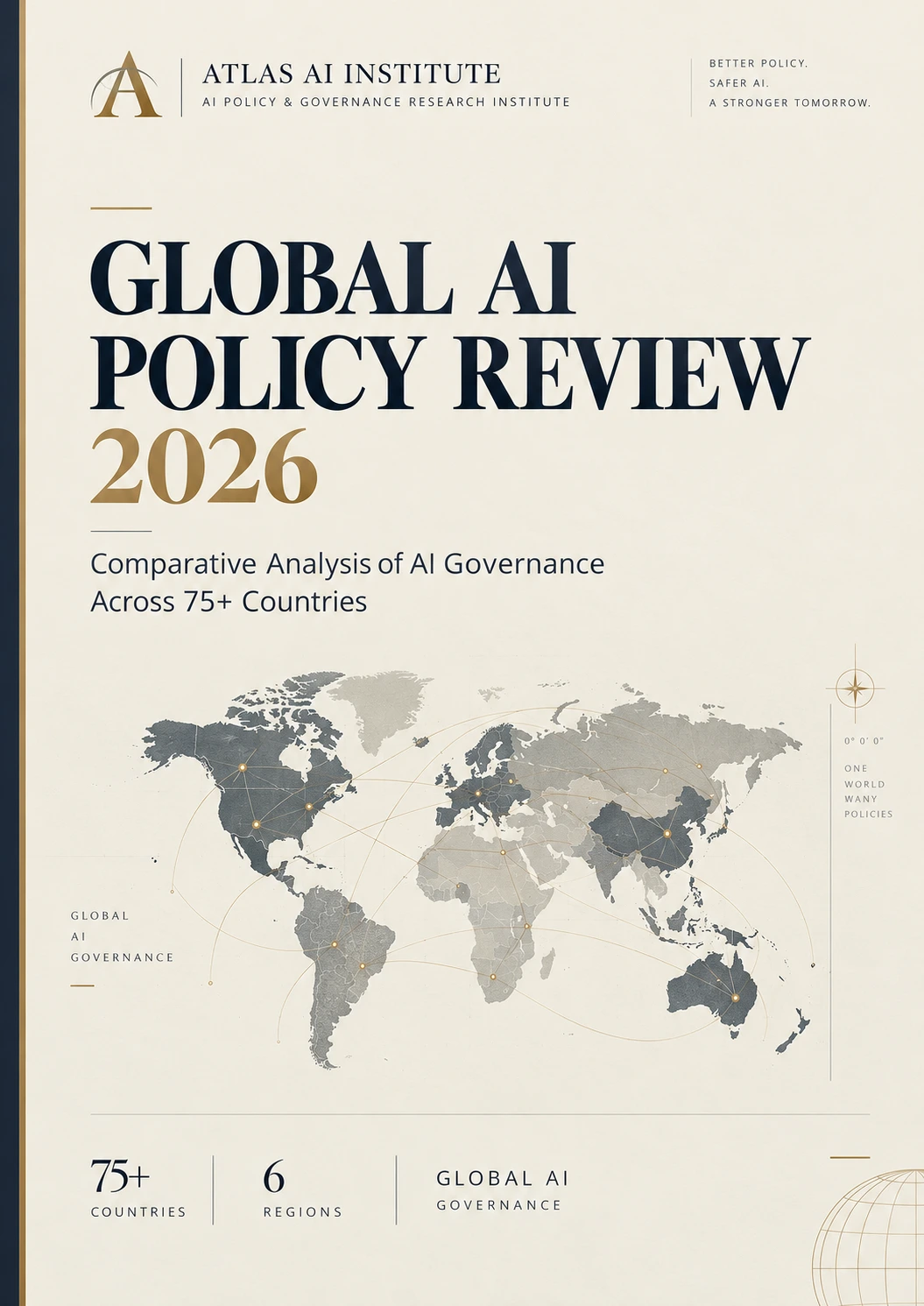
Global AI Policy Review
A comparative review of AI governance and policy developments across leading and emerging AI nations.
Read more →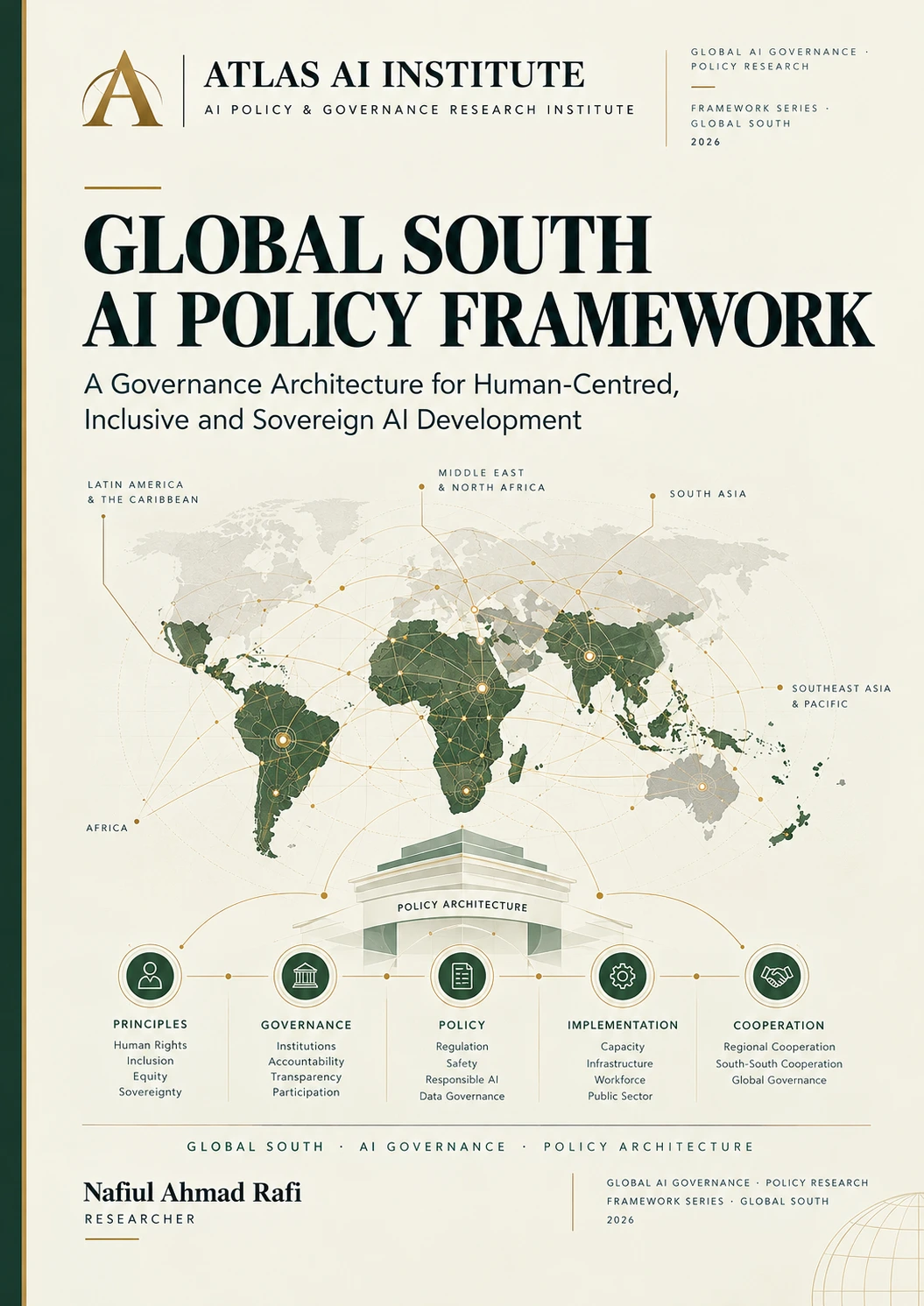 Policy Framework
Global South AI Policy Framework
An AI governance framework built for the institutional realities of developing economies.
Read more →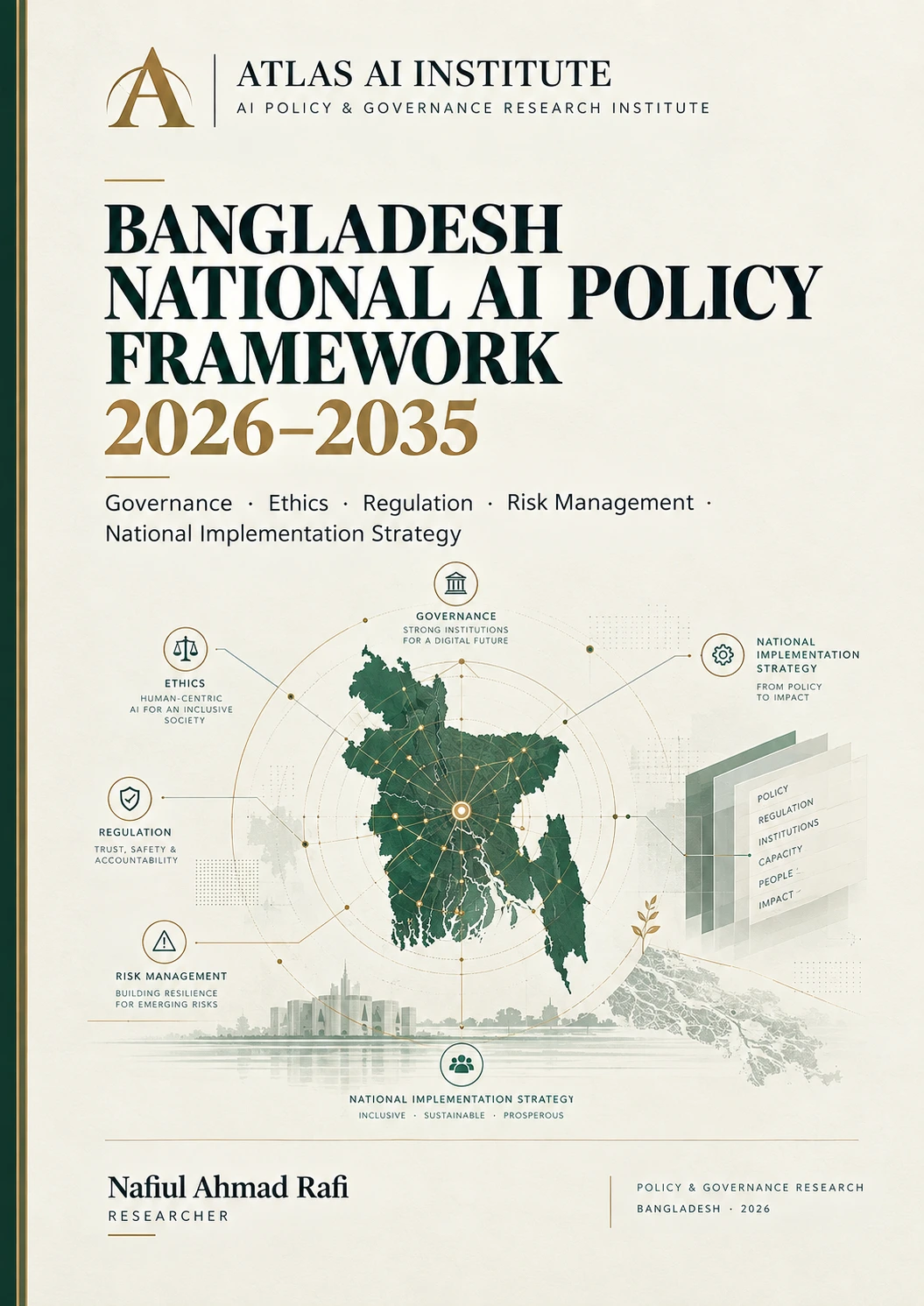 Policy Framework
Bangladesh National AI Policy Framework
A national AI policy framework for Bangladesh, assessing regulatory capacity and institutional readiness.
Read more →- AI Policy Analysis: 40 Global South Countries
- Global AI Policy Maturity Index (GAPMI) 2026
A four-part approach to AI governance readiness
How institutional readiness is assessed — from mapping capacity to representing Global South interests.
Assess
Map existing regulatory capacity and institutional gaps.
Compare
Benchmark against comparable developing economies.
Design
Draft governance frameworks fit for local context.
Advocate
Represent Global South interests in multilateral forums.
AI for Good: software and public-interest programmes
Applied governance research turned into working civic tools, policy intelligence and open infrastructure for Bangladesh, South Asia and the Global South.
Nagorik AI Assistant
An AI assistant that helps citizens navigate public services, government processes and civic information — in plain language.
ExploreFactCheckBD
A fact-checking platform countering misinformation and strengthening information integrity across Bangladesh.
ExploreAtlas OS
A Linux-based operating system for Android hardware — open, affordable and privacy-respecting.
ExploreClimate Intelligence
Real-time climate, disaster and environmental information for at-risk communities.
ExploreDigital Public Infrastructure
Open, scalable digital systems designed for public institutions and civic use.
ExploreAtlas AII Policy Hub
Centralised AI governance data and frameworks across 35+ countries.
ExploreAtlas AI Institute Global AI Policy Hub
Institutional-grade AI policy data, governance frameworks and legislative landscapes — research infrastructure for policymakers, researchers, think tanks and international organisations, aligned with UNESCO, OECD, NIST and G20 standards.
Explore Atlas AII →All projects →AI advisory for organisations making consequential decisions
Direct advisory for companies, governments, NGOs and universities — from readiness assessment to governance, risk controls and policy development.
AI Readiness Advisory
A baseline assessment of institutional, regulatory and data readiness before AI is adopted at scale.
Learn moreAI Governance & Risk Advisory
Governance structures, accountability lines and risk controls for AI systems already in operation.
Learn moreAI Policy & Framework Development
Drafting national, sectoral and organisational AI policies that fit local institutional realities.
Learn moreAI Strategy & Transformation Advisory
Roadmaps that connect AI ambition to institutional capacity and measurable outcomes.
Learn moreMedia, press & speaking
National press coverage, programme appearances and judging engagements — plus a ready-to-use bio for editors and event organisers.
Before AI enters Bangladesh's justice system, we must decide who is accountable
An op-ed on resolving accountability before AI is deployed in courts, tribunals and law enforcement — who answers for AI-assisted decisions.
Read on The Daily Star →
Short bio
Nafiul Ahmad Rafi is an AI governance and public policy researcher based in Dhaka, Bangladesh, and Founding Director of Atlas AI Institute. His work examines regulatory capacity and institutional readiness for AI in developing economies, drawing on comparative analysis of AI governance across 75 countries. He is AI Policy Endorser at the AI Policy Lab, Umeå University, Sweden.
Latest insights
Commentary on AI governance, policy and the Global South — updated automatically with every new post.
Frequently asked questions
Quick answers about the work, the institute and how to collaborate.
Who is Nafiul Ahmad Rafi?
Nafiul Ahmad Rafi is an AI governance and public policy researcher based in Dhaka, Bangladesh. He is the Founding Director of Atlas AI Institute and AI Policy Endorser at the AI Policy Lab, Umeå University, Sweden.
What does Nafiul Ahmad Rafi research?
He researches AI governance infrastructure, regulatory capacity, and digital policy frameworks for developing economies, using comparative AI policy and governance SWOT analysis across 75 countries.
What is Atlas AI Institute?
Atlas AI Institute is a Global South AI governance research and policy intelligence institute founded by Nafiul Ahmad Rafi in Bangladesh.
Where is Nafiul Ahmad Rafi based?
He is based in Dhaka, Bangladesh, and his research serves Bangladesh, South Asia, and the broader Global South.
What software and products has Nafiul Ahmad Rafi built?
Through Atlas AI Institute, he has built the Nagorik AI Assistant, FactCheckBD, Atlas OS, and the Atlas AII Global AI Policy Hub. A full list is available on the Software & Products page of his website.
Has Nafiul Ahmad Rafi been featured in the press?
Yes. He has written and been featured in national media, including The Daily Star op-ed 'Before AI enters Bangladesh's justice system, we must decide who is accountable,' alongside programme appearances, judging roles, and other media coverage.
Where can I read Nafiul Ahmad Rafi's latest insights?
His latest articles and commentary are published on the Insights section of his website, updated automatically whenever a new post is shared.
How can I collaborate with Nafiul Ahmad Rafi?
You can book an appointment through the Get in Touch link on his website, which connects to his scheduling page for research collaboration, speaking, and policy consultation requests.
Shaping AI governance for the Global South
Research partnerships, policy consultation and speaking engagements — for Bangladesh, South Asia and developing economies worldwide.